
Practice Areas
Were You Injured in a Slip and Fall Accident?
The first thing you should do before discussing your accident with anyone is to contact us at 800.341.2292.
- No Fee Unless We Win!
- Free Consultation!
- See What Your Case Is Worth!
- We Handle Property Damage On Your Behalf at NO Extra Cost!
- We Don't Get Paid Until You Get Paid!


Our team of professional Slip & Fall injury specialists at Tishbi Law Firm will schedule a free no obligation consultation. We will go over all the details of your accident to determine the best course of action. We can provide you with all the information you need to move forward with your claim. We will ensure you get the highest settlement possible and avoid some of the common mistakes.
Before you sign any documents with an insurance company, it is critical that you understand your rights. Insurance Companies are not on your side. They will do whatever they can to persuade you into signing off on their first offer. They will make no effort to properly assess the physical or psychological damages caused by the accident. Their only concern is to protect the company’s profits.
An insurance claims person will use some of these typical tactics:
- Ask you to provide a recorded statement regarding the accident and your injuries.
- Ask you to fill out complex paperwork to use it against you.
- Force you to be examined by their own medical specialists whose diagnosis usually conflicts with the medical report your doctor gave you.
- Claim your Slip & Fall injuries were pre-existing and not linked to the accident.
- Convince you that you are partially or completely liable for the accident.
- Tell you that your injuries are not nearly as serious as you claim.
- Offer you a ridiculously low settlement and pressure you to sign it by saying their next offer may be much lower.
- Most victims are very vulnerable after an Accident. They will use this to encourage you to make statements that can be used against you later to minimize the value of your claim.
This is why you need Tishbi Law Firm. We are highly skilled in fighting against insurance companies and protecting your rights. We deal directly with the insurance company to eliminate the pressure and stress they will impose upon you to settle.
Here are some common injuries from a slip and fall accident:
- Sprained Ankles or Wrists
- When the ligaments in your wrist or ankles tear during a fall, you get a sprain. Ligaments don’t receive a lot of blood, so sprains and strains can take a long time to heal. Even though it may not seem like a serious injury, an ankle or wrist injury can interfere with your life in a big way. You may not be able to type, cook or button a shirt. With an ankle sprain, you may not be able to walk. Sprains are a common problem after a slip and fall, and they can create significant problems for victims.
- Knee Damage
- Knee damage is common because you may twist as you fall. Knees are a complicated collection of bone and ligaments. When you hurt your MCL (Medial collateral ligament) or your ACL (Anterior Cruciate Ligament), it can take a long time to heal. In addition to ligament tears, you may also dislocate your patella. You may need knee reconstruction immediately or in the future.
- Shoulder Dislocation and Muscle Strains
- You might hit your shoulder as you fall. You may also reach out as you fall and jar your shoulder. Shoulder dislocations and strains may require immediate surgery. You may need to begin a treatment plan to determine a long-term prognosis for your recovery.
- Traumatic Brain Injuries
- Traumatic brain injury can occur in a fall even if you do not hit your head on the ground. When the brain gets a jolt you can still experience serious harm and you may not realize the severity of the injury. If left untreated, a traumatic brain injury can have secondary injuries that are even more serious.
- Cuts and Bruises
- A cut or bruise can result from any kind slip and fall. And although a cut may not seem serious, you can develop a blood clot or a severe infection.
- Soft Tissue Injuries
- Soft tissue injuries are not always visible, making them difficult to prove in a lawsuit. You might not even recognize that you have a soft tissue injury until days, or even weeks, after the initial fall. Left untreated, soft tissue injuries can cause chronic pain, and may also make you more vulnerable to subsequent injuries.
- Spinal Cord Injuries
- When the spinal cord is either severed or compressed. These injuries can be life-threatening, and they demand immediate medical care, as well as ongoing treatment. Spinal injuries are among the most costly to treat and they can run up to a million dollars or more in the first year. High cervical spinal cord injuries often produce quadriplegia or full paralysis, and lower spinal cord injuries may only produce paraplegia or paralysis of the lower limbs.
- Broken Bones
- A severe slip and fall can result in hip, wrist, and ankle fractures and broken bones. The older you are, the more likely you are to break a bone as a result of a slip and fall.
We are committed to getting you the highest settlement, and you pay nothing until we win your case.

We are committed to getting you the highest settlement, and you pay nothing until we win your case.
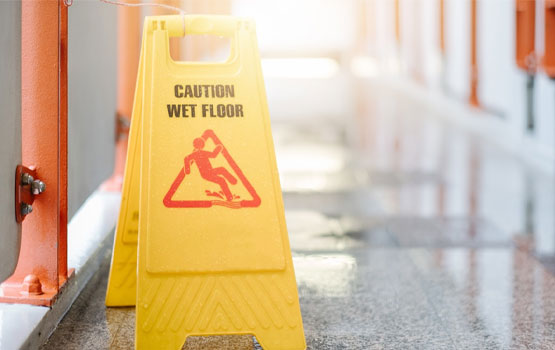
Wet Floor Warning Cone
OSHA requires all businesses to follow the guidelines and requirements to prevent a slip and fall accident by using a wet floor sign. However, it is not a law and some public buildings and businesses ignore this recommendation. An effective wet floor sign should draw the most attention and meet these requirements.
• A wet floor sign is required to have a yellow or green background with black letters
• A wet floor sign should appeal to the widest possible audience
• A wet floor sign must have an action word and a descriptive phrase such as Caution, Wet Floor or Attention, Slippery When Wet
• Warnings signs are required to contain all languages of the customers/employees demographic
• A sign needs to be readable from at least 5 feet away
• There are no height requirements on a wet floor sign or wet floor cone
What Is Premises Liability?
Premises liability is the legal term associated with claims where the victim seeks compensation from a property owner or other party responsible for injuries the victim has suffered. Slips and falls are one of the most common types of premises liability claims.
Here are some common causes of Slip & Fall accidents:
- Wet floors
- Plumbing leaks and slippery floors
- Defective stairs
- Broken or missing railings
- Loose carpeting and uneven floors
- Broken tiles or flooring
- Ditches or deep pot holes that are not properly marked
- Failure to rope off road or sidewalk construction
- Falls on sidewalks
- Falls due to icy conditions
- Failure to put up warning signs about known hazards
- Hidden obstacles such as wiring, cables or cords
- Broken furniture
Legal Theory
Most slip and fall cases are based on the legal theory of negligence. The objective is to prove the property owner was responsible for failing to act in a reasonable manner given the circumstances. The victim who is seeking compensation for their injuries must provide the burden of proof for each element of a negligence claim. This requires the victim; through their attorney, to establish that the events happened exactly as described.
Was the Property Owner's Conduct Reasonable?
One of the first questions that must be answered is whether the property owner knew about the dangerous condition that could have prevented an injury. As an example, someone may have spilled liquid on the floor and the restaurant employee immediately informed the manager and took steps to prevent customers from accessing the spill.
Sometimes it’s difficult to determine if the property owner actually knew about a dangerous condition. The law recognizes a concept known as “constructive knowledge,” meaning that the property owner should have been aware of the dangerous condition if they completed reasonable inspections.
These are some factors that can help establish constructive knowledge:
- The length of time the dangerous condition existed
- Was there a routine procedure in to check for and correct discovered hazards
- Did the property owner follow such a procedure
- Was the danger obvious
Was the Property Owner's Conduct Reasonable?
Property owners are required to take reasonable actions to protect their customers and guests from conditions that could lead to slip and fall accidents. In order to determine if the property owner breached their duty of care, the legal question is usually phrased as “Was the property owner’s actions reasonable under the circumstances?” To answer this question, it is necessary to look at the specific facts involved.
Were Guests Warned About the Dangerous Condition?
The major question is did the property owner act reasonably under the circumstances. Any warnings about the condition are relevant to making this determination. Did the property owner provide warning cones to alert guests or customers that the area was wet or slippery? A jury will consider if these warnings negate any negligence on the part or the property owner.
Could the Accident have Been Prevented?
A very common question is could the property owner have prevented the accident. There may be evidence that a safer option was available that that could have easily prevented the accident. An example: was there proper lighting that would have prevented the accident?
Evidence to Help Prove Your Claim?
The victim must prove their case in order to receive financial compensation. There is evidence that you can provide that will help substantiate your case.
Here are a few examples:
- Photos of the accident scene
- It is very important to get photos of the accident scene as soon as possible because the business or property owner may take steps to quickly erase the condition that caused your injury.
- Photos of your injuries and your clothing.
- Be sure to file a full detailed report with the manager, security department or police and make sure your injury is well documented and linked to the accident.
- Survey the area to see if anyone witnessed the accident and get their contact information.
As your lawyer, we may ask for surveillance footage that shows how the accident occurred.
Were You Negligent?
In premises liability cases, the victim’s own negligence can also be questioned. In some cases, the victim may be accused to have contributed to the accident.
Here are some questions the victim may be asked:
- Why were you at the place of the accident? Was this a legitimate reason?
- Would a reasonably prudent person in the same situation have noticed the dangerous condition in order to avoid the accident or taken other steps that would have prevented the accident, such as walking slowly around a wet surface or holding onto a handrail?
- Were there warning signs or barriers to prevent the accident but you ignored them?
- Were you distracted by texting or talking to a companion that prevented you from being reasonably cautious?
- Were you participating in any activity that could have increased your risk of slipping and falling?
These types of questions are likely to be asked by an insurance adjuster to determine if you helped contribute to your accident. They may also be asked during cross-examination if your case goes to trial.
Do I Have a Case?
It is very important to contact us as early as possible. We will explain your legal rights and provide communication between you and the insurance company. We will instruct you regarding the evidence you should collect and when to provide a statement to the insurance company.
Remember, the insurance company is not on your side. Insurance companies are in the business of making money, and they will do all they can to reduce your compensation. This is why you need Tishbi Law Firm, on your side. We understand how the insurance companies operate and we fight for every last dollar to maximize your claim.
California Slip & Fall Compensation
If you are injured in a slip & fall accident in California, you may be entitled to compensation for:
- All of your medical bills related to your slip & fall injury
- Any future earnings lost due to your injury
- Expenses for hiring a person or service to do household chores that you’re unable to perform because of your injury
- The repair or replacement of any personal property (such as a electronic device, mobile phone, eyeglasses, etc.) that was damaged or destroyed when you fell
- Lost wages (including time spent going to doctor’s appointments and physical therapy)
- Permanent disability and disfigurement resulting from the accident
- Emotional distress due to the the accident
- Any other costs you’ve incurred because of the accident
Work Related Slip & Fall Injuries in California
If you are involved in a slip & fall injury at work, you normally cannot sue your employer under California personal injury laws. Work-related injuries are covered under California worker’s Compensation Laws.

Comparative Liability
California law uses comparative liability to determine the percentage if liability of each party. This percentage of is used to calculate how much the property owner must pay in damages or compensation to the injured party and how much of the cost the injured party will have to bear.
I Was Injured on Government Property
If you were injured on government property city, state or federal entity is responsible for a person’s injuries when they slips and falls on the government owned property. Providing evidence, negligence and the other principles described above are still required in cases involving a government defendant.
Insurance Coverage
All businesses and most homeowners have insurance policies to protect their property. This coverage usually includes liability insurance to protect property owners from personal liability. If the property owner is found to be negligent, their insurance company will pay the claim. The insurance adjuster will try to negotiate the lowest settlement possible and there are sometime limits to what they can award. However, if the property owner is sued by the victim, a jury may award a higher compensation than the insurance coverage provides and the property owner will be responsible for paying any monetary amount that is in excess of the policy limit.
Call Tishbi Law Firm Immediately for a Free Consultation
We take on the big insurance companies so you are not forced by their clever lawyers to accept a quick and low compensation. We can often settle out of court, giving you faster access to funds and allowing you to focus on your physical and emotional recovery. We examine all the details to build a strong highly personal case to guarantee you receive the highest financial compensation and medical care.
If you’ve been injured by a slip & fall accident, call Tishbi Law Firm at 800.341.2292. You are our number one priority!
General Information
Although many people slip and fall every day while on property owned by another person or company, a simple slip and fall does not always result in a valid legal claim. When someone slips on spilled liquids, trips over wires or other obstructions, or falls down due to uneven surfaces, they often rush away from the scene, embarrassed and upset not realizing they may have sustained an injury.
You can have serious injuries by slipping and falling, and those injuries can leave you with expensive medical bills and missed days of work. All commercial property requires adequate insurance and almost all personal property has liability insurance. However, the insurance company will do their very best to pay the smallest settlement possible. This is why you need experienced legal counsel on your side and this is why you need an experienced personal injury lawyer like Tishbi Law Firm who is familiar with the laws concerning premises liability.